


The Phantom of the Opera
"The Phantom of the Opera" is a Gothic novel by French writer Gaston Leroux. It was first serialized in Le Gaulois from September 1909 to January 1910, and published in volume form in March 1910. The story is set in the Paris Opera House and centers on a disfigured musical genius known as the Phantom (Erik), who lives in the building's hidden underground and becomes obsessively devoted to the young soprano Christine Daaé.
Start

Main Characters
The Phantom / Erik: A masked figure haunting the Paris Opera House, possessing extraordinary musical and illusionist talents. He mentors Christine, falling deeply in love with her, but his possessiveness and jealousy drive him to terrorize the opera house. His real name is Erik.
Christine Daaé: A young Swedish soprano who rises from the chorus to stardom under the Phantom's secret tutelage. She finds herself caught in a love triangle between the Phantom and her childhood friend Raoul, and her empathy allows her to see the Phantom's vulnerability.
Raoul, Vicomte de Chagny: A wealthy aristocrat and Christine's childhood sweetheart. He reunites with Christine at the opera and becomes her suitor, representing stability and conventional love in contrast to the Phantom.
Core Plot
In 1880s Paris, the Palais Garnier is rumored to be haunted. When the lead soprano Carlotta falls ill, Christine is called upon to replace her and delivers a triumphant performance. Raoul recognizes her from the audience and comes backstage to reconnect. Christine reveals that she has been receiving vocal lessons from a mysterious "Angel of Music"—which Raoul suspects is actually the Phantom.
The Phantom's obsession with Christine deepens. He abducts her to his underground lair, and when she unmasks him, she sees his horrifyingly disfigured face. After she begs for release, he agrees on the condition that she wear his ring and remain faithful. Meanwhile, Christine tells Raoul about the abduction, and they plan to escape together. The Phantom overhears and, in a fit of jealousy, kidnaps Christine during a performance of Faust, threatening to blow up the entire opera house if she refuses to marry him. To save Raoul (whom the Phantom has trapped in a torture chamber) and everyone above, Christine agrees. In the end, Christine's compassion—she kisses the Phantom's forehead—overwhelms him, and he releases her and Raoul, allowing them to leave together.
Adaptations
The novel has been adapted numerous times, most notably the 1925 silent film starring Lon Chaney and Andrew Lloyd Webber's 1986 musical, which became a Tony Award-winning global phenomenon.
Start
The Phantom of the Opera
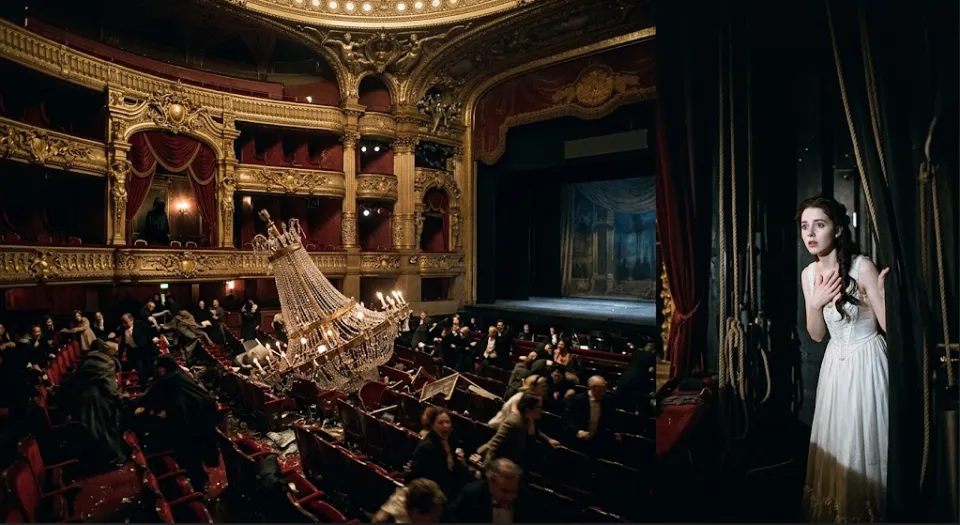 Chapter 1: The Ghost in the Opera HouseRead story
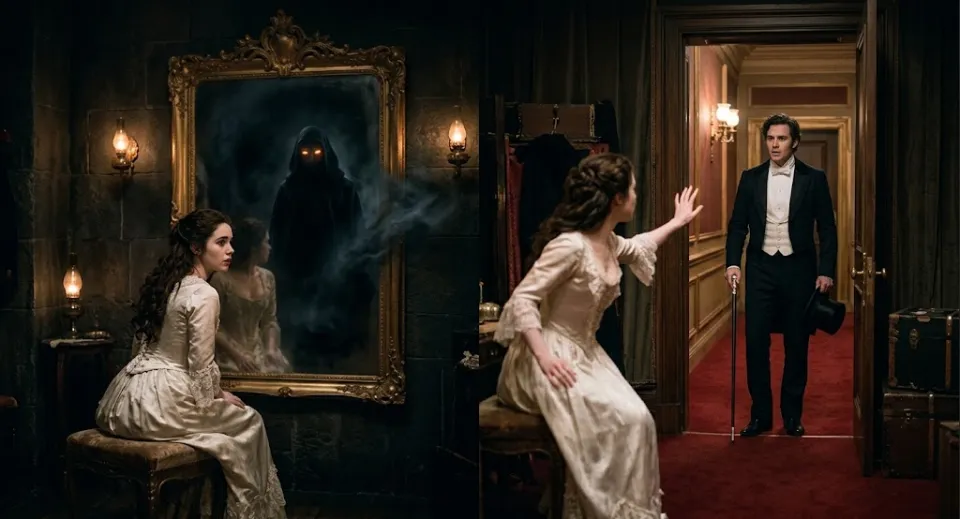 Chapter 2: The Angel of MusicRead story
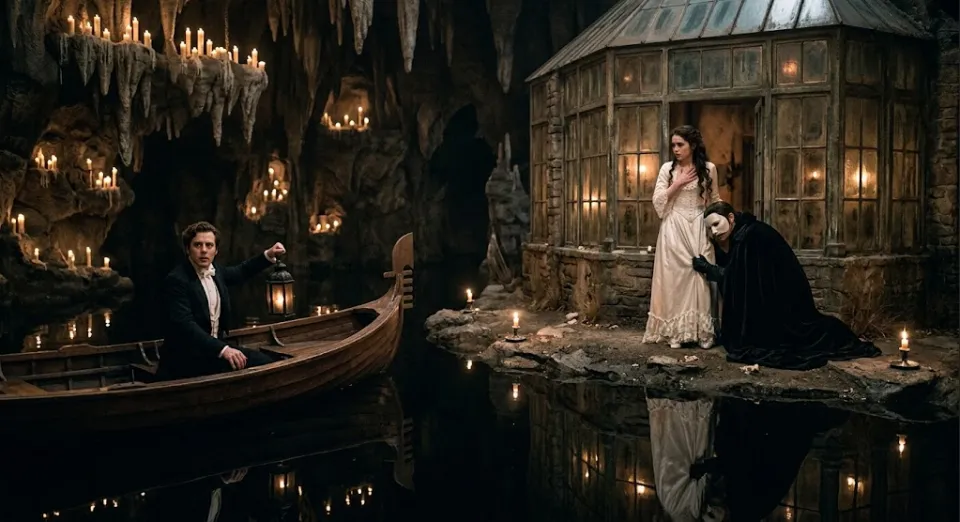 Chapter 3: The Labyrinth BelowRead story
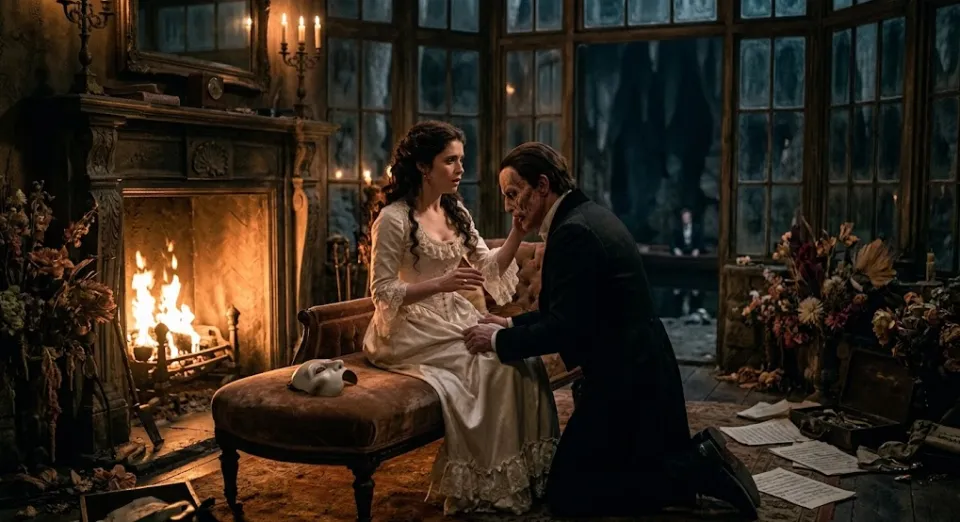 Chapter 4: The MaskRead story
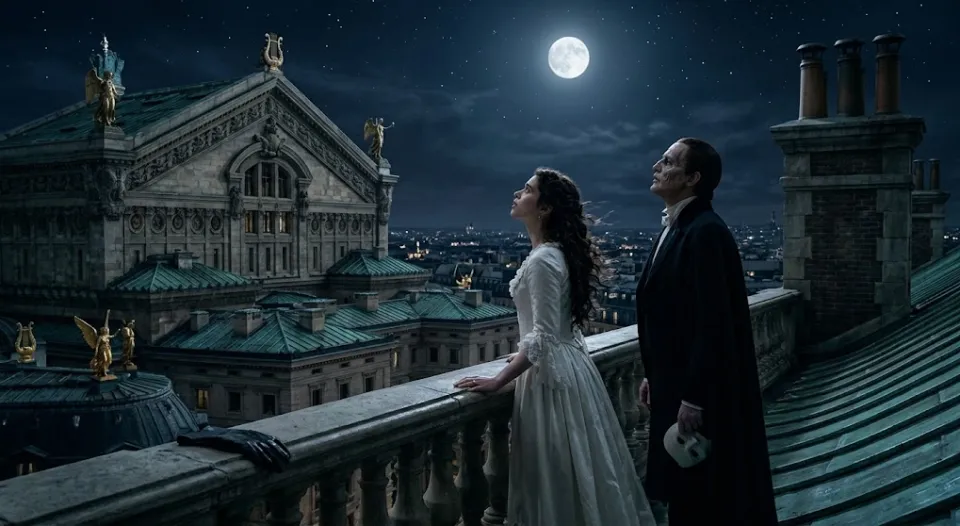 Chapter 5: The Opera Ghost's BrideRead story
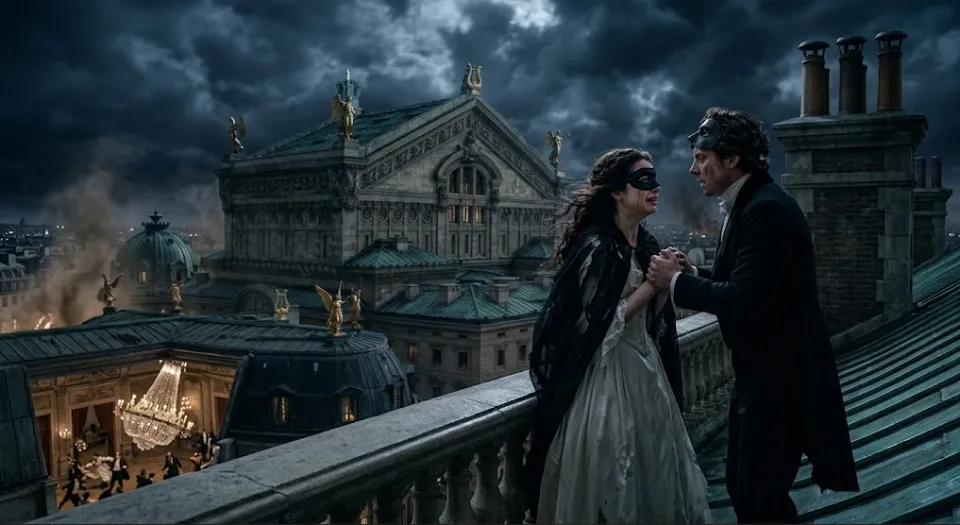 Chapter 6: The Storm at the Masked BallRead story
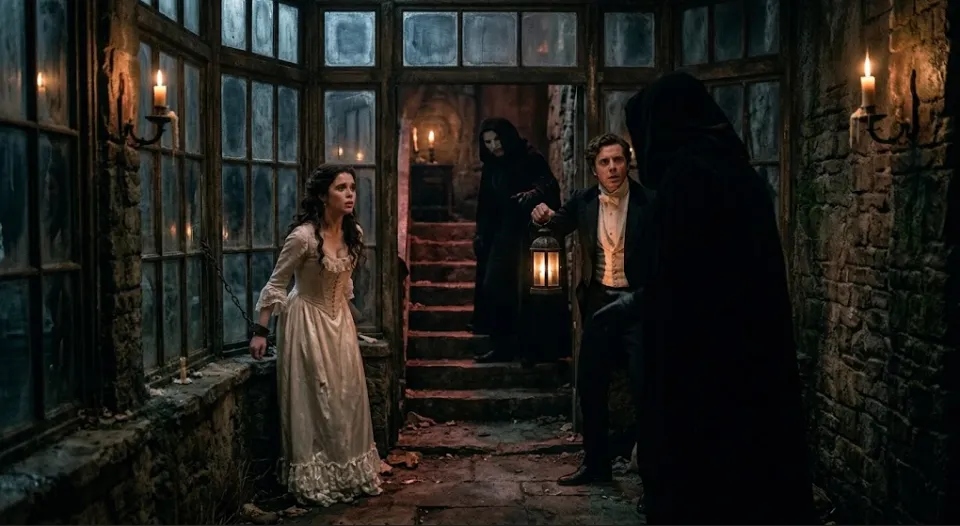 Chapter 7: The TrapRead story
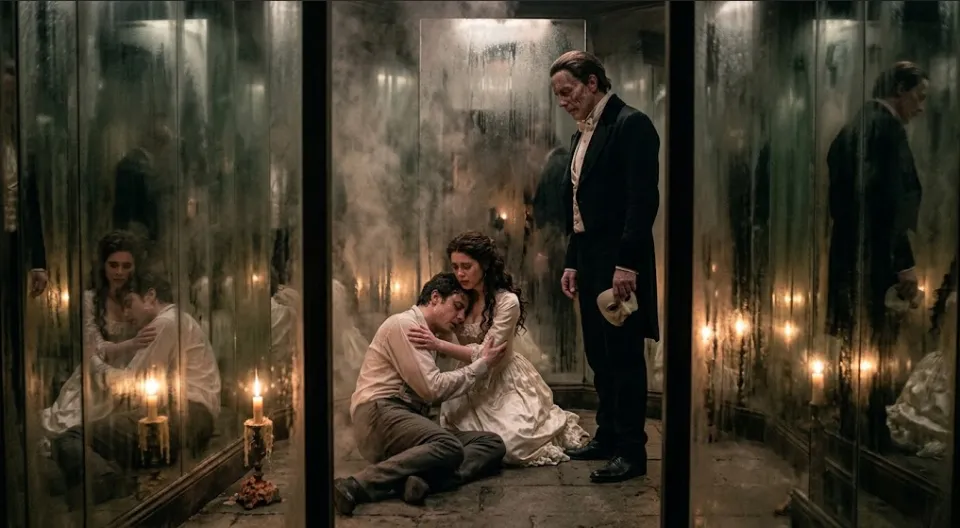 Chapter 8: The Torture ChamberRead story
 Chapter 9: The Ghost's FarewellRead story
 Chapter 10: The Door That Was Never OpenedRead story
Chapter 1: The Ghost in the Opera House
The Palais Garnier was the grandest opera house in the world, and it was haunted.
Everyone in Paris knew it. The ballet girls whispered about the ghost who sat in Box Five, a shadow no one could see but everyone could feel. The stagehands spoke of a voice that drifted through the corridors at night, low and beautiful and terrible. The managers laughed at such superstitions—until the day they received a letter written in red ink, signed simply: O.G.
Opera Ghost.
The letter demanded that Box Five remain empty for every performance, that a monthly stipend of twenty thousand francs be left in the manager's office, and that the new production of Faust be staged exactly as the ghost dictated. The managers, newly appointed and eager to prove themselves, ignored the letter entirely.
That was their first mistake.
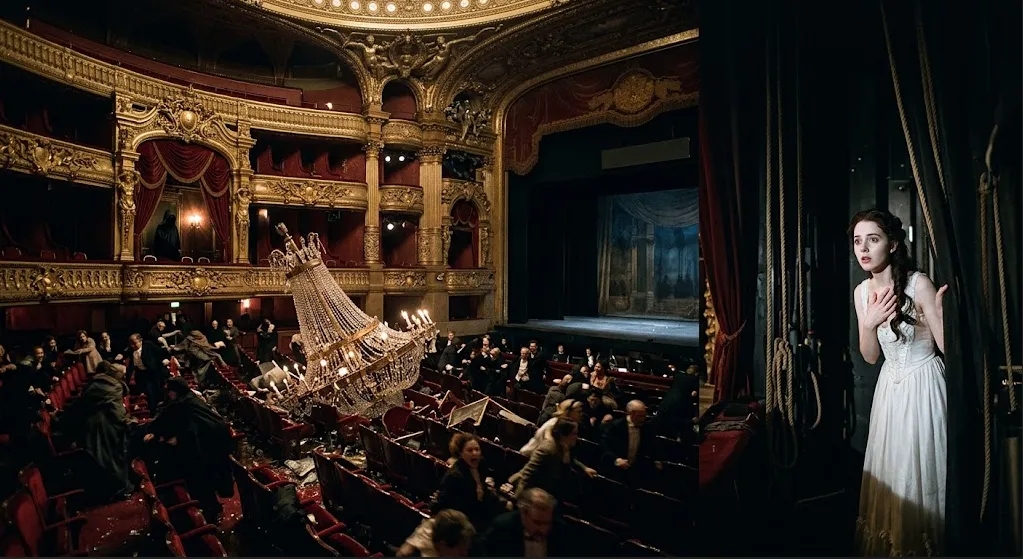
On the night of the gala, Carlotta, the company's reigning soprano, took the stage. She was magnificent—until the chandelier above the audience began to tremble. The great crystal fixture, weighing six tons, swayed once, twice, and then crashed down upon the seats below. One woman was killed. The gala ended in screams.
Among the chaos, a young soprano named Christine Daaé stood frozen in the wings. She had heard the voice that night—the voice that had been teaching her for months, the voice she believed belonged to the Angel of Music her father had promised would come to her. And she knew, with a cold certainty, that the crash was not an accident.
It was a warning.
Chapter 2: The Angel of Music
Christine Daaé had come to the opera house as a child, after her father's death. The great violinist had fallen ill during a tour of Europe and died in a small inn outside Paris, leaving his sixteen-year-old daughter alone in the world. The opera's new managers, taking pity on her, had given her a place in the chorus.
For three years, Christine sang only in the ensemble. Then, one night, she heard a voice in her dressing room.
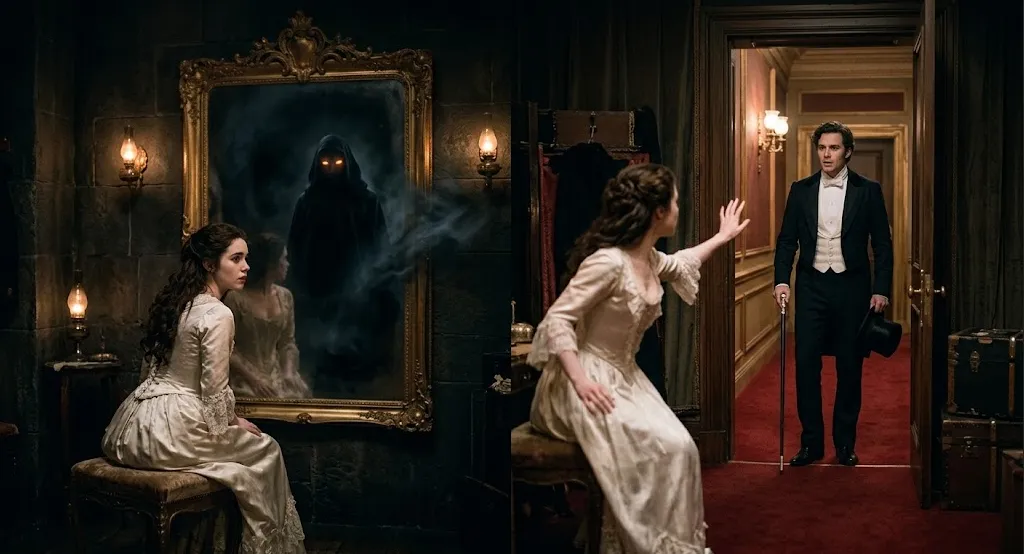
"Christine. I am the Angel of Music. Your father sent me."
She believed it. She had been raised on her father's stories of the Angel of Music, a heavenly spirit who taught only the purest souls to sing. And the voice was so beautiful—so impossibly beautiful—that she could not doubt it. Every night, the voice guided her through scales and arias, correcting her breathing, shaping her tone, drawing sounds from her throat she had never known she could make.
She never saw her teacher. He spoke from behind a mirror, from the shadows of her dressing room, from the darkness beyond the stage. But she felt his presence everywhere—a cold breath on her neck, a whisper in her ear, a hand that never quite touched her.
On the night of the gala, when Carlotta fell ill and the managers desperately needed a replacement, Christine was pushed onto the stage. She sang the role of Marguerite in Faust, and her voice soared through the opera house like a bird released from a cage. The audience wept. The critics rose to their feet. And in Box Five, a figure in black watched her with burning eyes.
After the performance, a man came to her dressing room. He was tall and handsome, with fair hair and anxious blue eyes.
"Christine," he said. "Don't you remember me?"
It was Raoul, the Vicomte de Chagny, her childhood friend. The boy who had retrieved her scarf from the sea when they were children, who had promised to protect her always. She had not seen him in years, and she stared at him as if he were a stranger.
"Raoul," she whispered. "You must go. He is here."
"Who?"
"The Angel of Music."
And from behind the mirror, a voice laughed.
Chapter 3: The Labyrinth Below
Raoul did not believe in ghosts. He believed in trickery, in illusion, in men who used smoke and mirrors to frighten the gullible. But he could not explain what happened next.
Christine vanished.
She had been singing in Faust again, and Raoul had been watching from a private box. In the middle of her great aria, the lights dimmed. When they came up again, the stage was empty. Christine was gone.
The audience gasped. The managers panicked. The police searched the opera house from top to bottom. But no one found her.
Raoul knew where to look. He had heard the stories—the underground lake beneath the opera house, the labyrinth of tunnels and chambers built by the architect who had designed the Palais Garnier. He had dismissed them as fantasy. Now he wondered.
He found the entrance behind a mirror in Christine's dressing room. It slid open at his touch, revealing a staircase that spiraled down into darkness. He descended, his heart pounding, and emerged in a world of shadows and water.
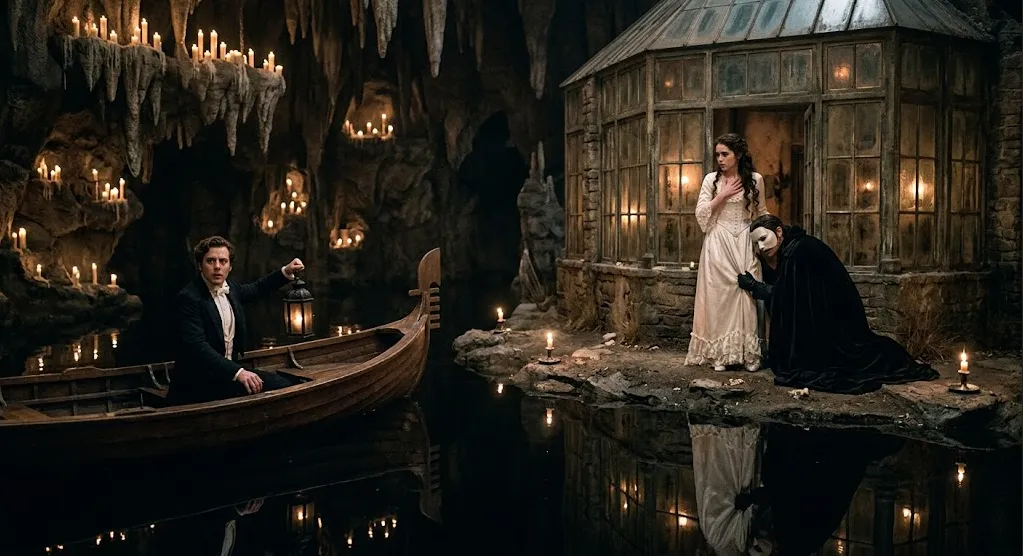
A gondola waited at the edge of an underground lake. Raoul stepped into it and pushed off, gliding through the silent cavern. Above him, the ceiling glittered with stalactites and candles. Below him, the black water was so still it mirrored the flames.
On the far shore, he saw a house—a strange, beautiful house built of stone and glass, rising from an island in the lake.
And there, on the threshold, stood Christine.
She was dressed in white. Her hair was loose. She was singing—a song he had never heard, a song that seemed to come from the depths of the earth itself.
And then a figure appeared beside her. A man in a black cloak and a white mask, covering half his face.
Raoul saw the man reach for Christine. He saw Christine draw back, her hands pressed to her chest. He saw the masked man fall to his knees, clutching at her skirt like a man drowning.
And then Raoul's boat scraped against the shore, and the masked man looked up.
His eyes, through the holes in the mask, were filled with fury.
Chapter 4: The Mask
The Phantom dragged Christine into his lair, and Raoul lost sight of them. He searched the island, the tunnels, the lake—but the house had no doors, no windows, no entrance he could find. He screamed Christine's name until his voice gave out, and then he collapsed on the shore of the black water, waiting for dawn.
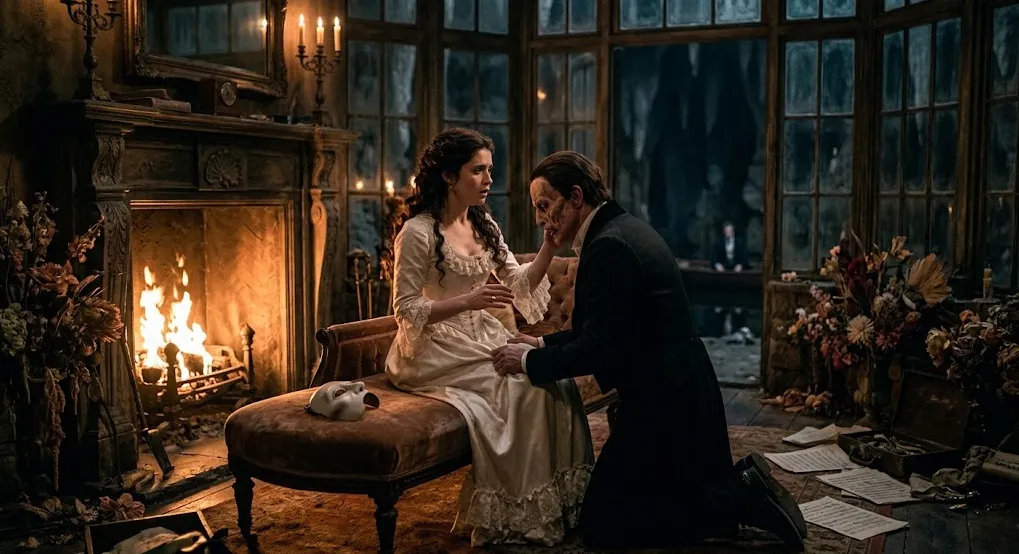
Inside the house, Christine sat on a velvet chaise in a room filled with flowers. The Phantom stood before her, his back to the fire.
"You have seen my face," he said.
"You brought me here," she replied. "I had no choice."
"You could have closed your eyes."
"I am not afraid of you."
He turned. The mask was in place, but she could see the edges of it, the pale skin and raw flesh beneath. He was trembling.
"You should be afraid," he said. "Everyone is afraid. My mother was afraid. She gave me this mask when I was seven years old. She said I was a monster."
"You are not a monster."
"I am. You will see."
He took a step toward her, and then another, and then he knelt before her and removed the mask.
Christine did not scream. She did not look away. She saw the ruined face—the sunken eye, the twisted mouth, the skin like melted wax—and she saw the man beneath it. A man who had lived in darkness for so long that he had forgotten what light felt like.
She reached out and touched his cheek.
"Poor Erik," she said.
He recoiled as if burned. "How do you know my name?"
"You are the voice I have heard all my life. You are the Angel of Music my father promised. And you are just a man."
Erik rose and walked to the far end of the room. When he spoke again, his voice was cold.
"You will stay here. You will wear my ring. You will sing for me alone. And you will forget your Raoul."
Christine looked at the golden ring on her finger.
"Or what?"
"Or I will destroy everyone you love."
Chapter 5: The Opera Ghost's Bride
Raoul did not wait. He went to the police, to the managers, to anyone who would listen. But the police found no evidence of a kidnapping. The managers, terrified of scandal, ordered him to be silent. And the newspapers, eager to sell copies, printed wild stories of a ghost who had stolen the opera's brightest star.
Christine, meanwhile, lived in the Phantom's house beneath the lake. Erik was a strange captor. He demanded her company but rarely touched her. He had bought her a piano, a library of books, dresses from Paris. He would sit at the organ and play for hours, and when he played, she could almost forget the underground lake and the darkness and the mask.
But he could not let her go.
One night, she discovered a secret door behind a curtain. It led to a small chamber where Erik slept—or rather, where he did not sleep. There was a bed carved into a coffin, lined with velvet. And on the bed lay a black silk ribbon, the kind a woman might wear in her hair.
Christine picked up the ribbon.
"Erik," she said, "who did this belong to?"
He was standing in the doorway. He looked at the ribbon and then at her.
"No one," he said.
"You keep a coffin in your room."
"Death has always been my only companion."
She put down the ribbon and walked to him.
"Take me to the rooftop," she said. "I want to see the moon."
He blinked. "The rooftop?"
"You have lived underground for so long. Do you ever miss the sky?"
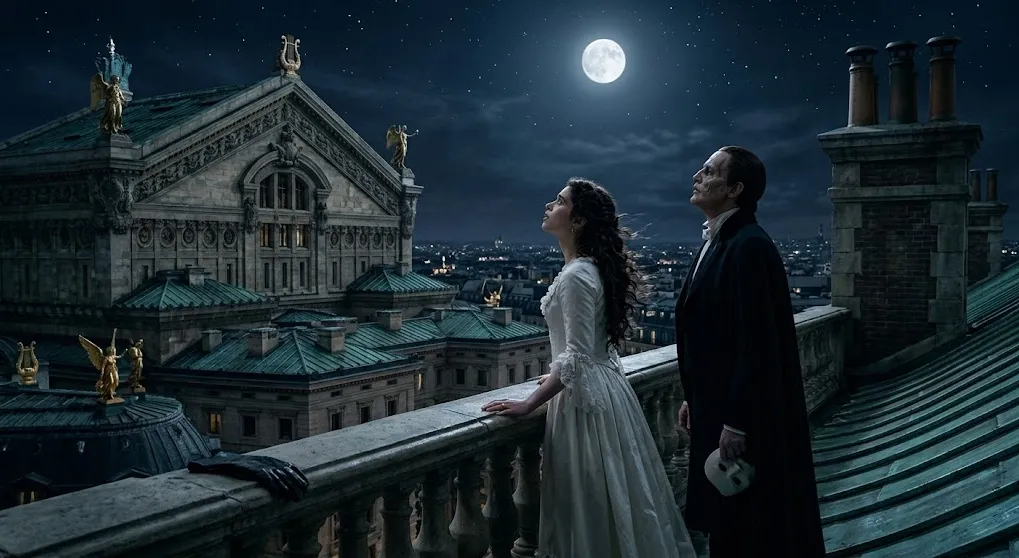
He said nothing. But he took her hand, and led her up a staircase she had never seen, and they emerged onto the roof of the opera house.
The moon was full. The city glittered below them. Christine looked at the stars and breathed the cold, clean air.
"Beautiful," she said.
She turned to him. He had removed his mask. The moonlight softened his ruined face.
"Do you think I could ever love you?" she asked.
He did not answer.
"You could," she said, "if you let me go."
Chapter 6: The Storm at the Masked Ball
Erik did not let her go. But he did something worse.
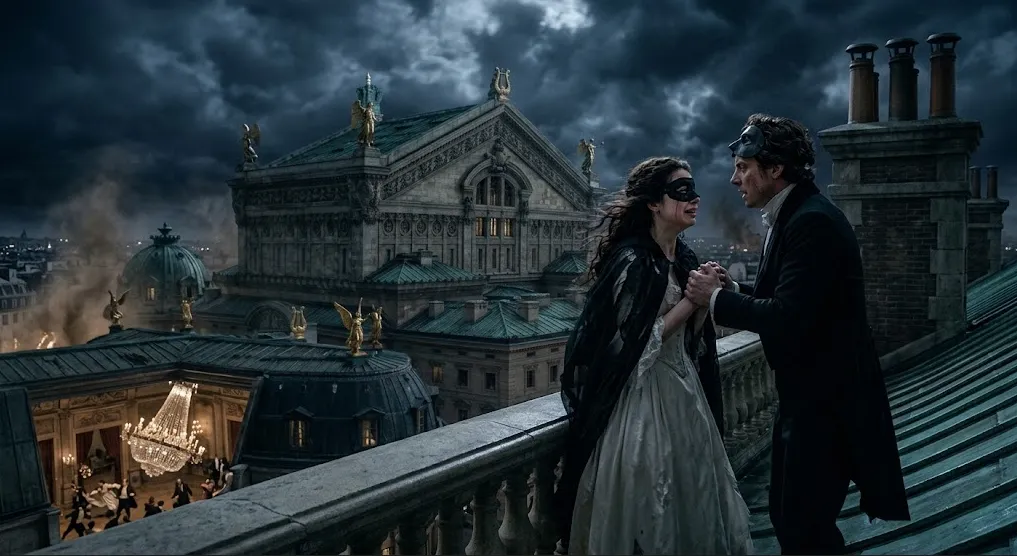
On the night of the great masked ball, the opera house was transformed into a sea of masks and gowns. Raoul, who had been searching for Christine for weeks, moved through the crowd, desperate for any sign of her. And then he saw her—dressed in black, her hair loose, a black domino mask covering her eyes.
"Christine!" he cried.
But she did not respond. She moved through the ballroom like a ghost, always just out of reach.
Then the music stopped. A figure appeared at the top of the grand staircase—a man in a black cloak and a white mask. The crowd fell silent.
"Welcome," the Phantom said, "to my opera."
He raised his hand, and the chandelier above the ballroom began to sway. The crowd screamed. People fled. Raoul fought his way through the chaos, searching for Christine.
He found her on the roof, not far from the place where he had first seen her with the Phantom. She was crying.
"Christine," he said, "come with me. Now."
"I can't."
"He will kill us both."
"If I go with you, he will destroy the opera house. He will kill everyone."
Raoul grabbed her hands.
"Then we stop him."
Christine looked at him—the boy she had known as a child, the man who had come to save her.
"How?" she asked.
"I have a plan."
Chapter 7: The Trap
Raoul's plan was simple: expose the Phantom to the public. If the world saw the ghost for what he truly was—not a supernatural creature but a man—he would lose his power.
But Erik was already one step ahead.
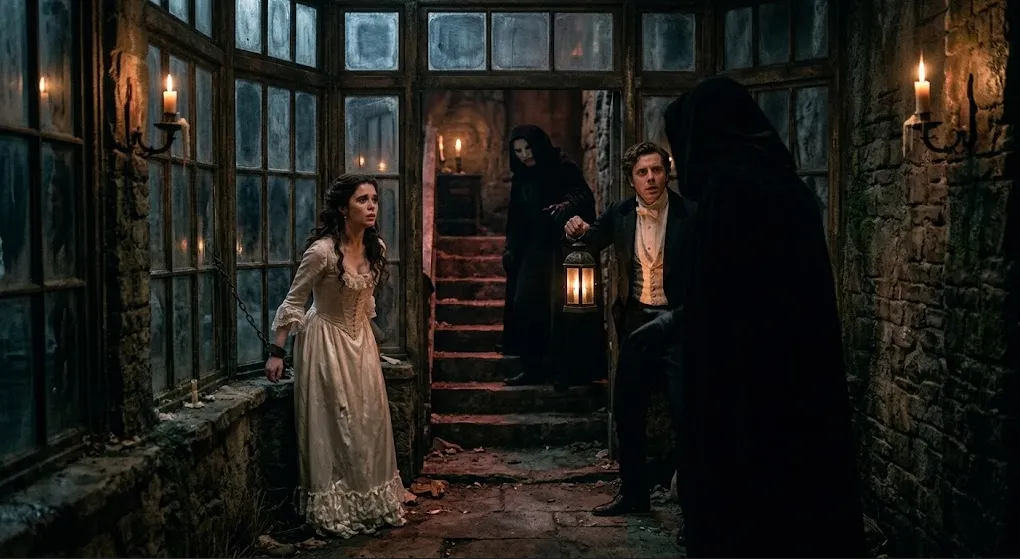
On the night of the planned trap, Raoul and Christine arranged to meet in her dressing room. He would bring the police. She would lure the Phantom into the open. But when she stepped into her dressing room, Erik was already there.
"Hello, Christine," he said.
"I—I was expecting Raoul."
"I know."
He walked toward her, and she backed away.
"I know everything," he said. "I know about your plan. I know about the police. I know about the secret tunnel you planned to use. And I know what I must do now."
He grabbed her wrist. She screamed, but no one heard. He dragged her through the mirror, down the staircase, into the underground lake. He did not speak. He did not look at her. He just rowed the gondola in silence, his hands trembling on the oars.
When they reached the house, he chained her to a wall in the cellar.
"You will stay here," he said, "until you forget him."
"I will never forget him."
"Then you will never leave."
He left her in the darkness. She heard the gondola depart. She heard the water close over it. She was alone.
Then she heard Raoul's voice.
"Christine!"
He had followed them through the tunnels. He found the house. He found the cellar. But Erik found him first.
Chapter 8: The Torture Chamber
Erik did not kill Raoul. Killing was too simple.
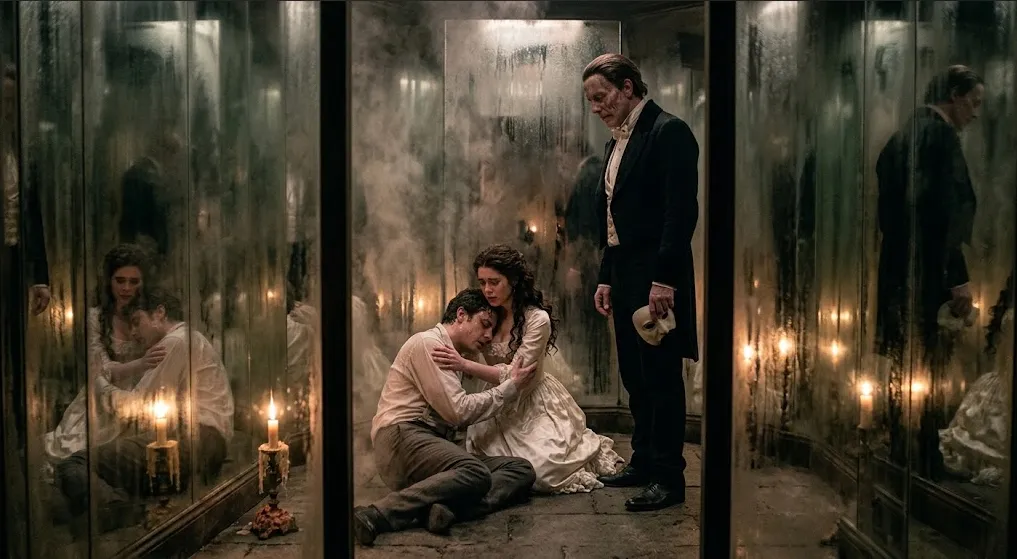
He sealed him in a chamber with mirrored walls that reflected his own image a thousand times. The mirrors were heated, and the temperature rose slowly, hour by hour. Raoul screamed, but the sound only bounced back at him. He clawed at the walls, but they were smooth and unbreakable.
He was trapped in a room of his own reflection.
Christine, in her cellar, heard him. She heard his screams, his pleas, his prayers.
"Erik!" she screamed. "Let him go!"
The Phantom appeared at the door.
"Say you will marry me," he said, "and I will release him."
"Never."
"Then he will die."
She heard Raoul's voice crack. She heard him beg for water. She knew he could not last much longer.
"Alright," she said. "I will marry you."
Erik opened the cellar door and led her to the chamber where Raoul was trapped. The mirror walls were steaming. Raoul was curled on the floor, his skin red and blistered.
"Let him go," Christine said.
"Say it."
"I will marry you."
Erik looked at her. And for a moment, she thought she saw something like tenderness in his ruined face.
"No," he said. "You will never marry me. Not like this."
He released Raoul, who collapsed into Christine's arms. The Phantom stood over them, his mask in his hand.
"Go," he said. "Both of you. Go."
They ran. They found the tunnel, the gondola, the surface. They burst into the opera house and called for the police. They searched the underground lake, the house, the tunnels. But Erik was gone.
Chapter 9: The Ghost's Farewell
Christine did not know that Erik had stayed behind.
After she left with Raoul, he had gone to his house beneath the lake. He had smashed the mirrors in the torture chamber. He had burned his collection of masks. He had sat at his organ and played one final, soaring chord.
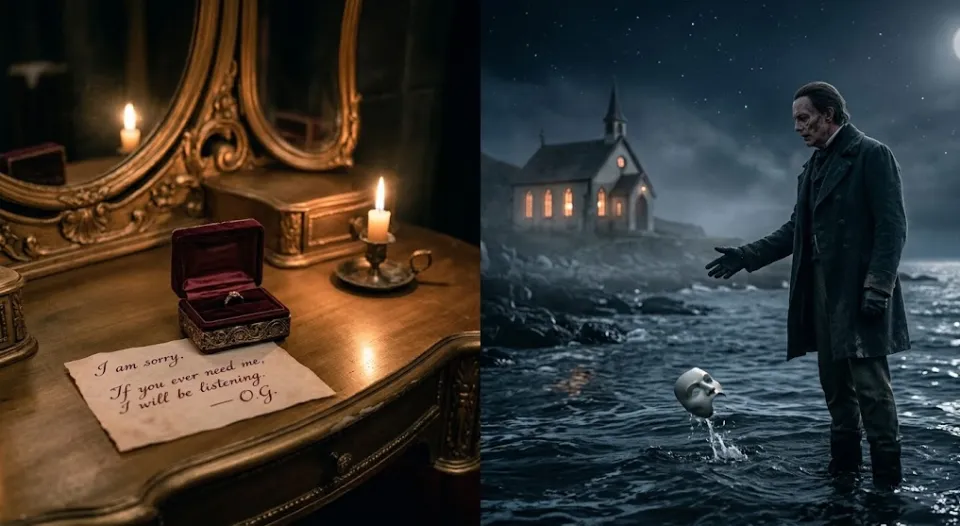
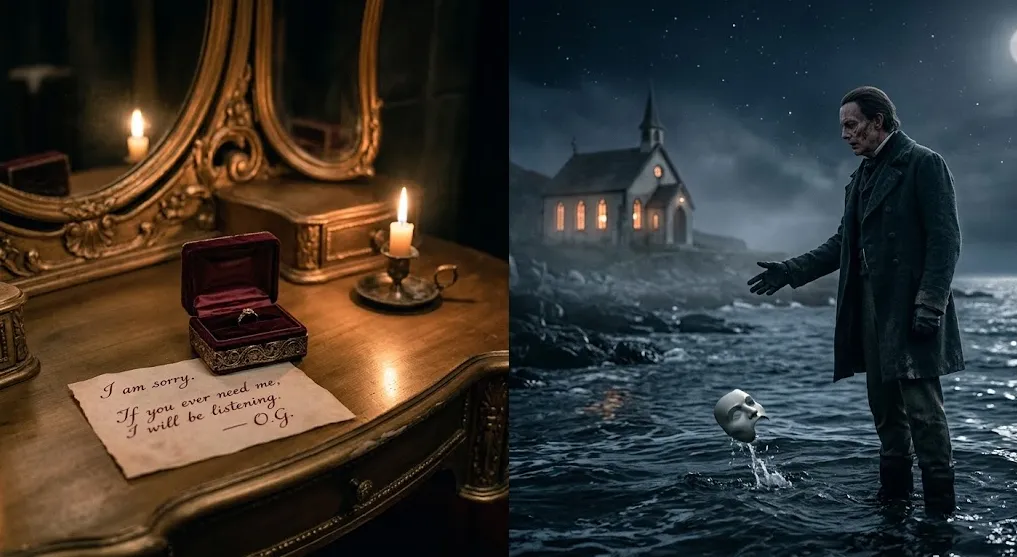
Then he had gone to her dressing room, which was empty, and placed a small velvet box on her dressing table. Inside was a golden ring and a note written in red ink:
"I am sorry. If you ever need me, I will be listening. — O.G."
He left the opera house for the last time and took a train to the coast. He found a small inn by the sea and rented a room. He spent his days walking along the shore, his mask hidden in his coat pocket. He watched the waves and listened to the gulls and wondered what it would be like to be loved.
One night, he heard a voice singing.
He followed it to a small church by the sea. Inside, a woman in white was singing at a wedding. It was Christine.
He stood in the shadows and listened. When the song ended, he turned and walked back to the sea. He stood at the edge of the water and looked at the stars.
"I am tired," he said.
And he let the mask fall from his hands and drop into the water.
Chapter 10: The Door That Was Never Opened
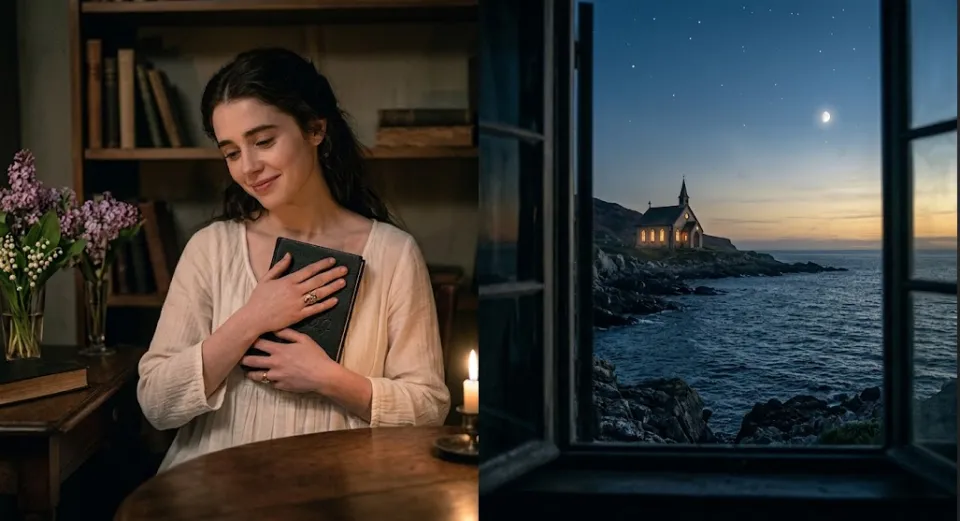
Raoul and Christine were married in the spring. They moved to a small house outside Paris, and for a time, they were happy. But Christine never forgot the Phantom.
She never told Raoul, but she sometimes woke at night and listened for a voice that did not come. She sometimes sat at her piano and played a tune she could not name. She sometimes looked at the mirror in her bedroom and wondered if it might open.
And then, one day, she received a package.
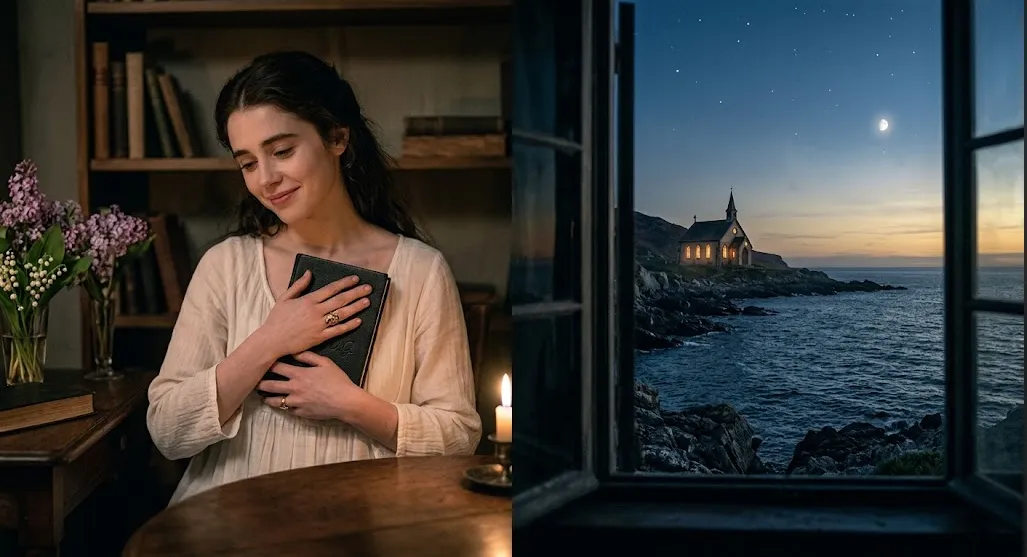
Inside was a small book, bound in black leather. The pages were handwritten in red ink. It was a novel—a novel about a ghost who loved a singer, a phantom who lived beneath an opera house.
She knew the story. It was hers.
On the last page, a single sentence had been added:
"I have told our story so that others may know I was not a monster. But I have hidden my name, as I have hidden my face. Farewell, Christine."
She closed the book and held it to her chest. She did not cry. She was done crying.
She placed the book on her shelf and went to the window. The sun was setting over the sea. She watched it until it was dark.
And then, for the first time in years, she smiled.