
The Worldview of "AI Lobsters": Phison’s K.C. Pua on the Rise of Hybrid AI
The Worldview of "AI Lobsters": Phison’s K.C. Pua on the Rise of Hybrid AI
AI龍蝦的世界觀 群聯潘健成:混合式 AI 崛起
小编推荐
The Worldview of "AI Lobsters": Phison's K.C. Pua on the Rise of Hybrid AI
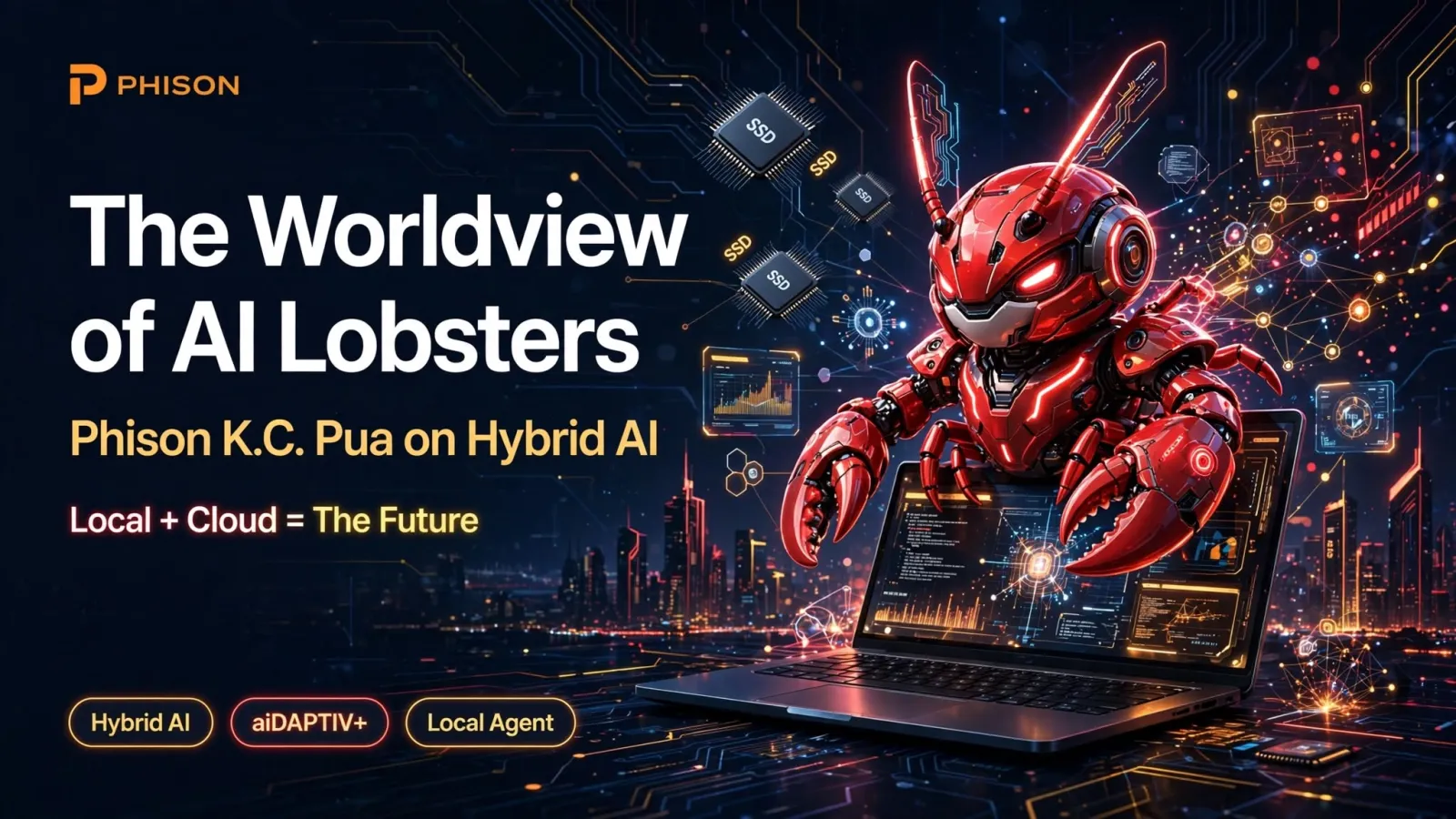
A red lobster took over China in early 2026.
Not a seafood trend. A software trend.
People called it 「養龍蝦」- raising a lobster. It meant installing an always-on AI agent on your own computer, letting it send emails, organize files, book flights, run your social media, and work for you while you sleep.
The lobster came from OpenClaw, an open-source, locally-run AI agent created by Austrian developer Peter Steinberger, released in November 2025. Its logo is a red lobster. In China, it exploded because it promised something ChatGPT never did: not just talking to you, but acting for you.
And that is exactly why Phison CEO K.S. Pua — the man known as the father of the USB drive — thinks the lobster is not a fad. It is a preview of the next world order.
His worldview can be summed up in one sentence:
AI will not live only in the cloud. It will live beside you, in your PC, in your factory, in your pocket. That is Hybrid AI.
1. From Chatbot to Employee: Why the Lobster Matters
The first wave of AI was a chatbot. You ask, it answers.
The lobster is different. OpenClaw can execute real-life tasks such as sending emails, organizing files or even booking flight tickets. It is an agent, not an assistant.
Pua calls this shift from AI that talks to AI that works.
In his view, the real revolution is not a smarter model. It is millions of small, personal agents — lobsters — each working for one person, one team, one factory.
That changes everything about infrastructure:
- A chatbot needs a short conversation.
- An agent needs long memory, long context, constant access to your files, your calendar, your data.
- A chatbot can live in a distant data center.
- An agent needs to live where your data lives — locally, privately, always-on.
2. Pua's Heresy: The Bottleneck Is Not Compute, It's Memory
While the whole industry is obsessed with GPUs, Pua says everyone is looking at the wrong bottleneck.
"In AI models, the real bottleneck isn't computing power - it's memory," Pua said. "If you don't have enough memory, the system crashes."
Think about it. A modern LLM is memory-hungry. The fast memory on a GPU runs out well before its compute does. A capable local model plus long context plus your OS simply cannot fit in a typical 16GB or 32GB PC.
That is fatal for lobsters. A lobster that forgets, crashes, or has to constantly ask the cloud for help is not a reliable employee.
Phison's answer is aiDAPTIV+.
Instead of treating DRAM and SSD as separate worlds, aiDAPTIV+ turns them into one tiered memory pool. GPU VRAM for what is active right now, DRAM for what is needed soon, and high-capacity, cheap NAND flash SSD for everything else — the inactive Mixture-of-Experts (MoE) experts, the evicted KV-cache, the long-term memory of your lobster.
The result, according to Phison's internal testing, is striking: it can support a 120B parameter model using 32GB of DRAM instead of 96GB.
In plain language: use cheap, infinitely scalable SSDs to act as DRAM.
Pua's logic is brutally pragmatic. DRAM and HBM are expensive and in short supply. NAND flash is cheap, abundant, and Phison already powers more than one in every five SSDs shipped worldwide. Why fight for scarce memory when you can expand memory with storage?
This is not a technical tweak. It is a worldview: AI should be democratized by making memory cheap, not by making GPUs bigger.
3. Hybrid AI: Why Your Lobster Can't Live Only in the Cloud
If lobsters live only in the cloud, three problems appear, and Pua sees all three clearly:
1. Cost: Tokens are rent.
Every time your lobster acts in the cloud, you pay per token. An always-on agent that works 24 hours a day would bankrupt you in token fees. Hybrid AI routes the routine, private, repetitive work locally, and only sends the hard, rare reasoning to the cloud. Phison demonstrated this with Intel: a hybrid LLM routing application built on OpenClaw, showing how larger MoE models can run locally with aiDAPTIV while reducing reliance on cloud token usage.
2. Privacy: Your lobster knows too much.
A true agent has access to your email, files, and business data. Sending all of that to a distant cloud is a security nightmare — and one reason the lobster fever in China later cooled as security fears mounted. Local execution means your data stays on your machine.
3. Latency and Reliability: A worker can't wait.
Phison focuses on Time to First Token (TTFT) — the delay between your prompt and the AI's first word. By keeping frequently used cache on high-capacity SSDs, aiDAPTIV+ keeps GPUs focused on computation instead of stalling for data. For an agent, that difference is the difference between feeling like a colleague and feeling like a laggy chatbot.
Hybrid AI is Pua's answer: Cloud for intelligence, Local for execution. Cloud for training, Local for working.
4. "AI Is a Necessity, How Can There Be a Bubble?"
When people ask Pua about an AI bubble, his answer is famously blunt:
"AI is a necessity, how can there be a bubble?"
He argues we have only run for 3 years, there are 17 more to go.
Why is he so confident? Because he sees AI not as a stock story, but as infrastructure — like electricity, like the internet, like USB.
He invented the single-chip USB flash drive. He watched storage go from a niche to a necessity. He sees the same pattern now: AI machines will generate 1,000 times more data than humans.
That data has to be stored, remembered, and acted on somewhere. That somewhere is memory + storage. That is Phison's home turf.
And he also warns of the flip side: if memory stays scarce and expensive, many consumer electronics companies may close as AI devours global supply. The companies that survive will be those that learn to do more AI with less expensive memory — exactly what aiDAPTIV+ is built for.
5. The Worldview: Everyone Gets a Lobster, Everyone Needs a Local Brain
Put it all together, and Pua's worldview of AI Lobsters looks like this:
Old Worldview (Cloud AI):
Your laptop becomes a stable for your lobster. Your SSD becomes its memory. Your local AI becomes its brain.
Pua also calls for "AI blue-collar" skills — people who can localize open source and tailor systems to real-world applications. In other words, the future will not be built only by model researchers in Silicon Valley. It will be built by thousands of local builders who teach lobsters to do real jobs in real factories, real shops, real homes.
That is why he is bringing that vision home to Malaysia with Malaysia AI Storage (MaiStorage) — a technology transfer worth over RM1 billion, bringing 200 experienced engineers back to Selangor.
He is not just selling SSDs. He is trying to seed a local ecosystem where lobsters can be raised.
Old Worldview (Cloud AI):
- One giant model in one giant data center
- You rent intelligence by the token
- Your data leaves you
- Only big companies can afford real AI
- Millions of small agents, each owned by one person
- Intelligence is split: heavy thinking in cloud, daily work on-device
- Your data stays with you
- AI becomes a personal employee, not a public chatbot
Your laptop becomes a stable for your lobster. Your SSD becomes its memory. Your local AI becomes its brain.
Pua also calls for "AI blue-collar" skills — people who can localize open source and tailor systems to real-world applications. In other words, the future will not be built only by model researchers in Silicon Valley. It will be built by thousands of local builders who teach lobsters to do real jobs in real factories, real shops, real homes.
That is why he is bringing that vision home to Malaysia with Malaysia AI Storage (MaiStorage) — a technology transfer worth over RM1 billion, bringing 200 experienced engineers back to Selangor.
He is not just selling SSDs. He is trying to seed a local ecosystem where lobsters can be raised.
6. What This Means For You
You don't need to buy Phison stock to learn from Pua. You just need to ask three questions:
1. Where does my AI live?
If all your AI lives in the cloud, you are renting. Start experimenting with one local agent for one private workflow — note-taking, file organization, local coding.
2. What is my memory strategy?
For your business, the bottleneck will not be "do I have the smartest model?" It will be "does my AI remember enough, fast enough, cheap enough?" Hybrid is cheaper than pure cloud, and more private.
3. Am I raising a lobster, or just chatting?
Chatting is consumption. Raising a lobster is delegation. Give your agent a real job, a real workflow, and real boundaries. Let it work while you think.
The lobster fever in China showed the hunger is real. People don't just want AI to answer questions. They want AI to do work.
Pua's bet is that the companies that win the next 20 years will not be those that build the biggest cloud. They will be those that make it possible for everyone to raise their own lobster, locally, affordably, and safely.
The lobster is not the product. The lobster is the proof that AI has moved from the data center into your life.
And once it moves in, it never moves out.
Sources & Further Reading: Phison × Intel collaboration on local AI workloads, Phison aiDAPTIV+ at CES 2026, and reporting on OpenClaw / "raising a lobster" in China.